Amplitude
Compare the five Amplitude integrations Statsig offers and choose the one that matches the data you need to move between the two products.
Statsig offers five separate Amplitude integrations. Each integration moves a different kind of data in a different direction, and you configure each integration independently. Pick the integration that matches the data you need to move, then go to its setup page.
Choose an integration
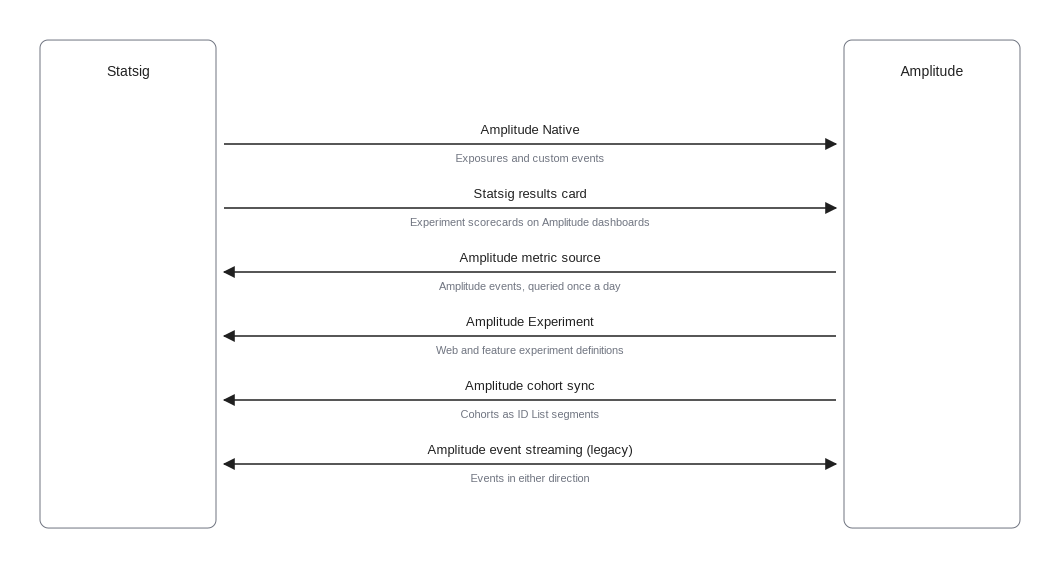
| Integration | Direction | What it moves | Deployment | Status |
|---|---|---|---|---|
| Amplitude Native | Statsig to Amplitude | Exposures and custom events, through the project link | Cloud and Warehouse Native | Early access |
| Amplitude events as a metric source | Amplitude to Statsig | Amplitude events as the basis for Statsig metrics | Cloud | Early access |
| Amplitude Experiment | Amplitude to Statsig | Amplitude web and feature experiment definitions | Cloud and Warehouse Native | Early access |
| Amplitude cohort sync | Amplitude to Statsig | Amplitude cohorts as Statsig ID List segments | Cloud | Generally available |
| Amplitude (event streaming) | Both | Events in either direction | Cloud | Legacy |
Use Amplitude Native when you want Statsig exposures and events queryable in Amplitude. Amplitude Native works only after you link your Statsig organization to an Amplitude organization.
Amplitude event streaming is a legacy integration. It's still supported, but the other integrations in the table cover most of what it does, so use it only when you need one of the following:
- Amplitude events delivered into Statsig Cloud as raw events
- An Amplitude project that isn't part of the linked organization
Amplitude Native and Amplitude event streaming can both forward exposures. Enabling both for the same Amplitude project duplicates those exposures in Amplitude, so enable only one of the two for a given Amplitude project.
Availability
Amplitude Native, the Amplitude metric source, and the Amplitude Experiment integration aren't enabled for every account. Contact your Statsig or Amplitude account team to request access.
Link your Statsig and Amplitude organizations
Amplitude Native, the Amplitude metric source, and the Statsig results card in Amplitude dashboards depend on a one-time link between your Statsig organization and your Amplitude organization. Amplitude event streaming, Amplitude cohort sync, and the Amplitude Experiment integration don't need the link, because all three authenticate with API keys instead.
Create the link from a Statsig organization-admin account whose email address also has administrator access to your Amplitude organization. Statsig verifies the Amplitude side of the link with that email address.
- Find your Amplitude organization ID. The organization ID is the number after
/org/in any Amplitude settings URL, for exampleapp.amplitude.com/analytics/org/46900/settings. - In Statsig, go to Settings > Manage Account > Info and select the Organization tab.
- Under Amplitude Linked Organization, enter your Amplitude organization ID and save.
After the organization link exists, link individual projects. Statsig maps one Amplitude project to each Statsig environment and marks one project as Primary.
- In Statsig, go to Settings > Manage Account > Info and select the Project tab.
- Under Amplitude Linked Projects, select an Amplitude project for each Statsig environment.
Start with a test project
You can't remove forwarded events from an Amplitude project after Amplitude ingests them, and there's no historical backfill. Link a test or non-production Amplitude project first, confirm the data is correct, then move to production.
Regional support
Only US-hosted Amplitude projects support Amplitude Native and the Amplitude metric source. If your Amplitude organization uses the EU data center, use Amplitude event streaming instead.
The Amplitude Experiment integration isn't limited to the US. When you configure the integration, select the region that matches your Amplitude data residency.
Was this helpful?
For AI agents: a documentation index is available at /llms.txt. Append .md to any page URL for markdown, or send Accept: text/markdown.