For AI agents: a documentation index is available at /llms.txt. Append .md to any page URL for markdown, or send Accept: text/markdown.
Participating Units
Understand how Statsig Warehouse Native counts participating units, including exposure rules and how to interpret unit counts in experiment results.
Definition
In Statsig, Participating Units (sometimes called participating users) are a subset of an experiment's total exposed unit count relevant to a particular metric. They count units with a non-zero denominator value for metric types that require a numerator and denominator. Statsig uses these units in statistical calculations for ratio-based metrics.
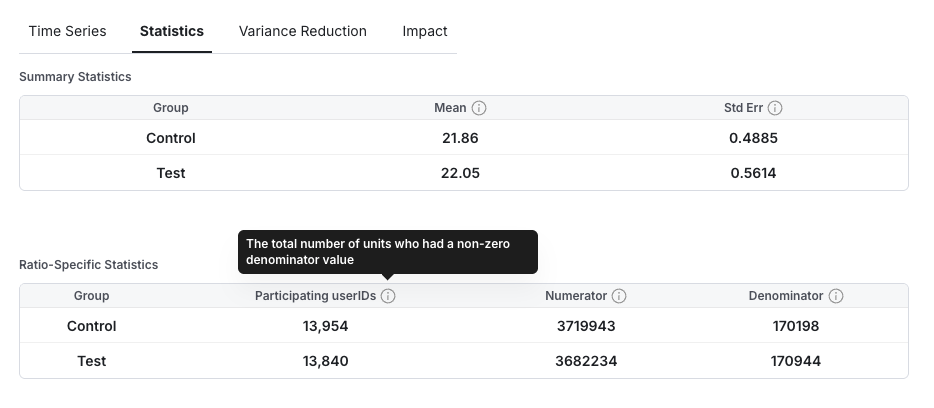
Statsig computes ratio metrics only for users with a non-zero denominator value. For example, a user must trigger the denominator event on a given day for Statsig to include them in the daily ratio. Statsig excludes users who don't trigger the denominator event during an experiment from the test vs. control comparison of a ratio metric.
Example
An example of this type of metric for an e-commerce company could be "Total Items Purchased per Order", measuring the average basket size. The numerator is the count of total items bought, and the denominator is the total number of orders submitted. If you run an experiment on the checkout flow, only users who had at least one Order event count in the "Total Items Purchased per Order" ratio metric.
Was this helpful?