For AI agents: a documentation index is available at /llms.txt. Append .md to any page URL for markdown, or send Accept: text/markdown.
Prompts & Graders
Manage AI prompts and graders in Statsig to evaluate, version, and roll out prompts in production without deploying code, similar to dynamic configs.
What is a prompt in Statsig
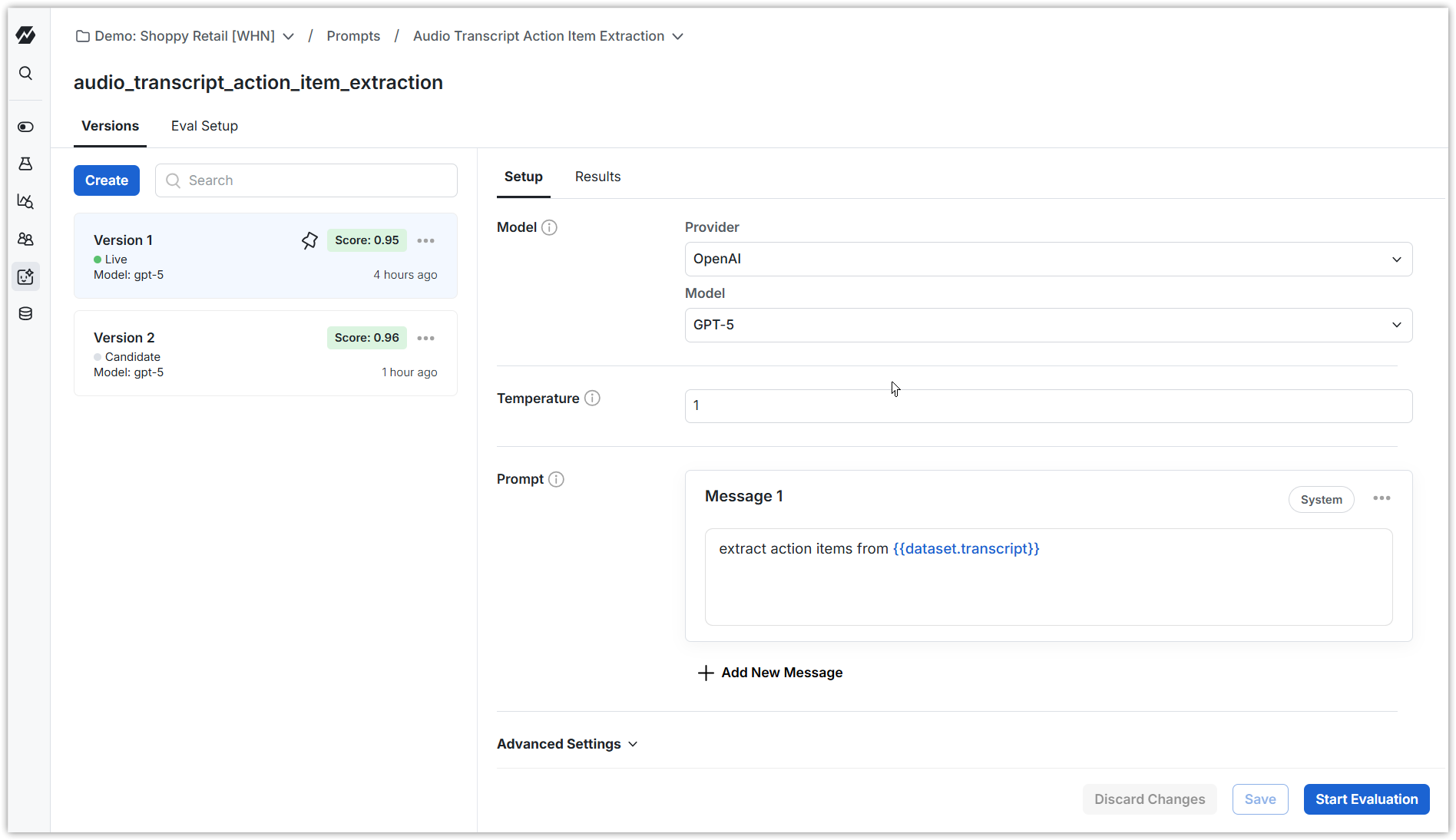
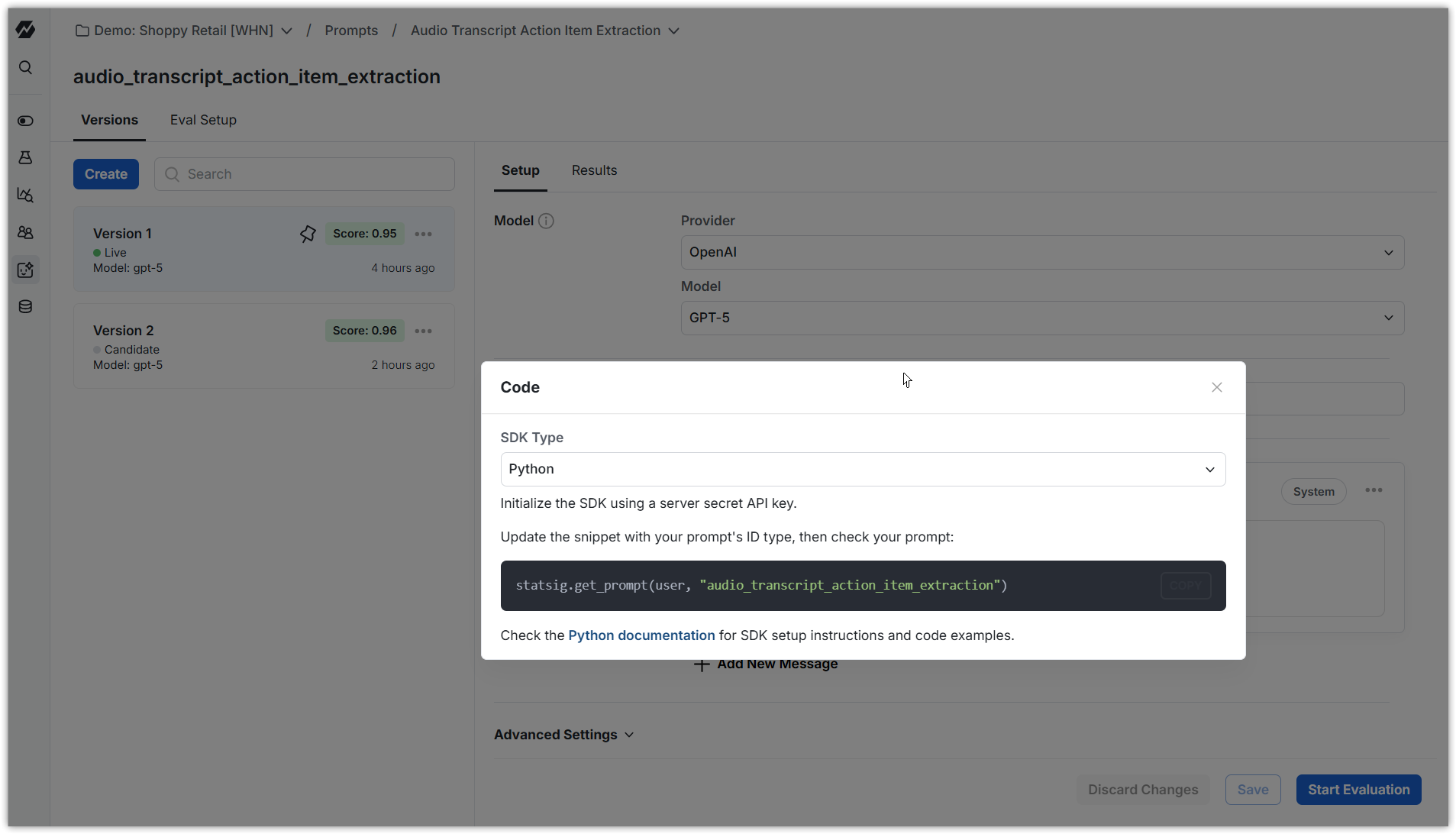
A Prompt represents an LLM prompt or task in Statsig, along with its config. Prompts are similar to Dynamic Configs: you can evaluate and roll out prompts in production without deploying code. Use the Statsig Node or Python AI SDKs to retrieve a prompt within your app at runtime.
With Prompts, you can:
- Manage prompt configuration outside of your application code. You can update the model, configuration, or prompt at runtime.
- Allow teammates with access to Statsig to collaborate and iterate on prompts, benefiting from Statsig's production change control processes and versioning.
- Add configuration for a new model or model provider and progressively shift production traffic to it while comparing costs, user satisfaction, or any metric of interest.
- Support advanced use cases such as retrieval-augmented generation (RAG) and evaluation in production.
What is a grader
A grader is the evaluation component that scores or judges the output of an AI system against a target standard.
The grader is the core evaluation unit in the workflow:
- Input: The grader takes in the AI model's response and, when available, a reference answer from your dataset.
- Process: The grader applies a scoring method (refer to the grader types below).
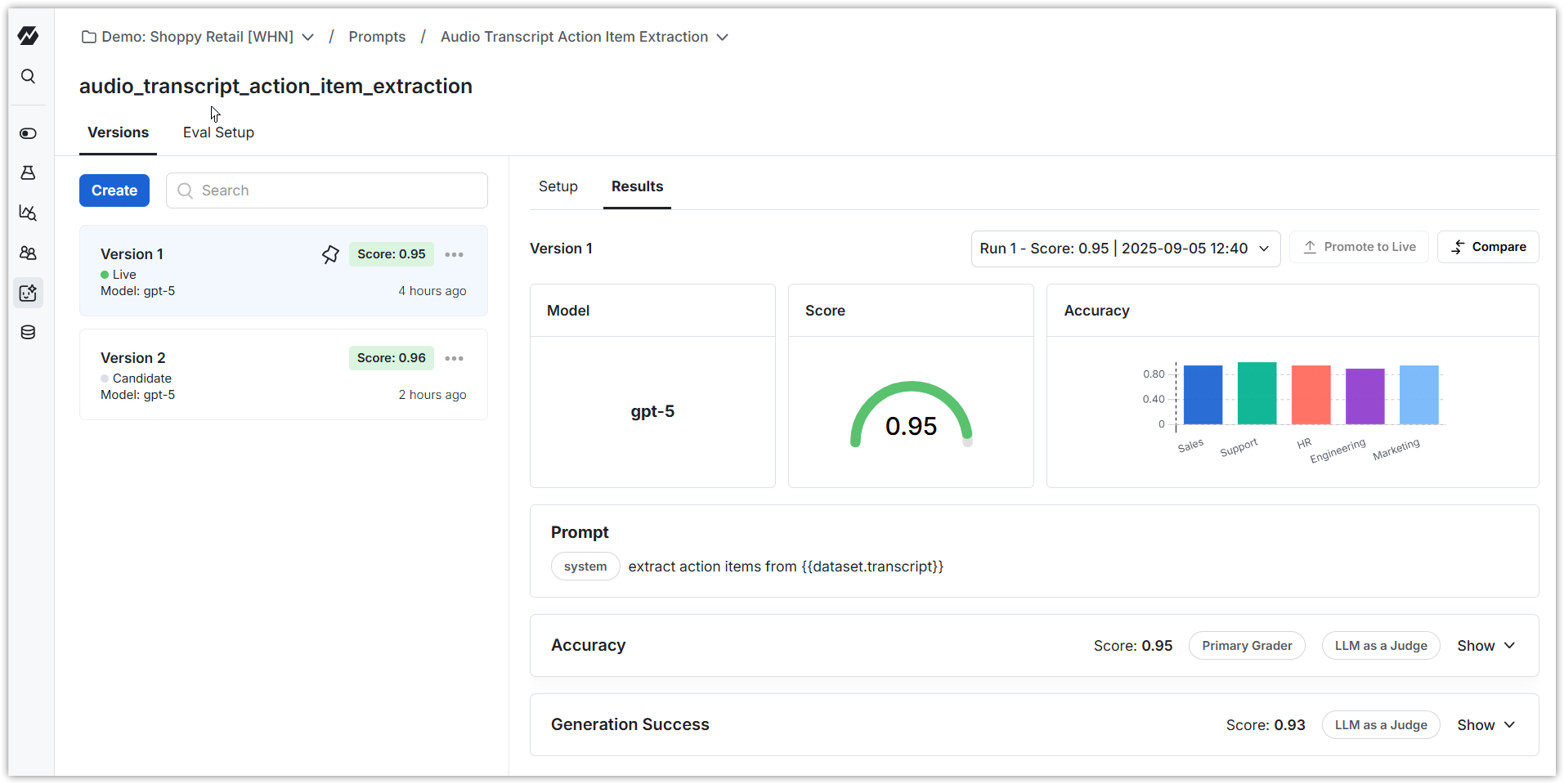
- Output: The grader produces a score between 0 and 1. This score feeds into your eval results so you can compare performance across datasets, versions, and experiments.
Statsig offers four grader types:
- LLM as a Judge: Another model scores the output against a rubric you write. Reference the model output with
{{output}}. - String Comparison: Check whether
{{output}}equals, doesn't equal, or contains a reference column value. - Text Similarity: Score how close
{{output}}is to a reference column, using a function like fuzzy match or cosine similarity. - Python: Score the output with your own Python.
What is a primary grader
When a prompt has more than one grader, you can mark one as the primary grader. Its score becomes the version's overall score, the headline number you compare across versions. Set it from the grader's menu with Set as Primary.
What is a critical grader
A critical grader is a must-pass evaluation in Statsig AI Experimentation. If the AI output fails this grader, Statsig marks the entire run as failed. A critical grader enforces non-negotiable requirements, acting as a hard gate before Statsig considers results valid. When it doesn't fail, it acts like a normal grader.
Use case
For example, in a financial support chatbot, a critical grader could check that the model never fabricates account balances. Even if the response is otherwise helpful, a single failure blocks the model's promotion.
Was this helpful?