For AI agents: a documentation index is available at /llms.txt. Append .md to any page URL for markdown, or send Accept: text/markdown.
Participating Units
Understand how Statsig counts participating units in an experiment, including exposure rules, deduplication, and how to interpret unit counts in results.
Participating units, also called participating users, are the exposed units that have a non-zero denominator for a metric that divides a numerator by a denominator, such as a ratio metric. Statsig uses only these units in the statistical calculations for those metrics, so their unit count is smaller than the experiment's total exposures. Check this number when a ratio or mean metric's unit count looks lower than the Cumulative Exposures chart. The calculation details table on the metric drill-down page lists which metric types (ratio, mean, and retention metrics) use participating units.
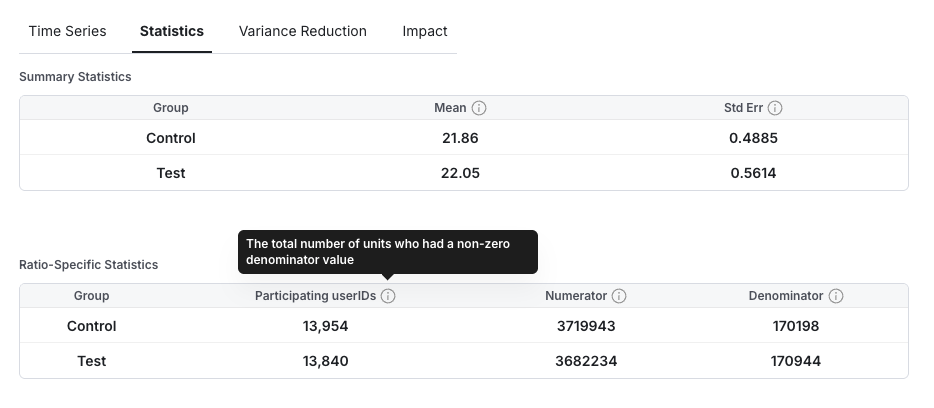
Statsig includes a unit in a daily ratio only if it triggered the denominator event that day. Statsig excludes units that never trigger the denominator event during the experiment from the test vs. control comparison for that metric.
Example
An e-commerce company measures average basket size with the ratio metric "Total Items Purchased per Order": the numerator is the count of items bought, and the denominator is the number of orders submitted. In an experiment on the checkout flow, Statsig includes only users with at least one Order event in that metric.
Was this helpful?