Project Access Management
Manage project-level access in Statsig by assigning roles to invited users, configuring permissions, and controlling who can edit gates and experiments.
This guide applies only to on-demand customers. If your organization has set up SSO, refer to the SSO Guides for information about managing access permissions through SSO.
In the Basic Settings page you can configure who has access to your project. Each person invited to a project receives a role that specifies their level of access.
Roles
The different Project Roles available are:
| Role | Description |
|---|---|
| Read-Only | Users with this role can only read data on the project. This includes reading gate and dynamic config configurations, experiment data, and metrics. Any actions users with these roles take that attempt to edit the configuration for the project fail. |
| Member | Users with this role can read data for a project and edit configurations within the project. This includes being able to create and modify: Feature Gates, Dynamic Configs, Holdouts, Experiments+, etc. |
| Admin | Users with this role have the same access as Member but can also modify project access settings. This includes inviting new users to the project and changing roles for existing users of the project. |
| Owner | Only the user that created a project receives the Owner role. The Owner has the same access as Admin but can also delete the project and configure automatic invitations for the project. If you need to change the Owner of a project, the current owner can change it by going to Settings > Project Members & Invites, selecting the person, and editing their role to Owner. |
Custom roles
Custom roles are for Enterprise contracts only. Reach out to the support team, your sales contact, or the Slack channel to enable Enterprise features.
Enterprise customers can customize roles used to assign permissions in Statsig. You can create new roles beyond Admin, Member, and Read-Only and choose what permissions these roles have. Common use cases include creating a Metrics Admin role or a Warehouse Admin role (for Statsig Warehouse Native).
Granular delete permission for configs
Statsig can split the Edit or delete configs permission into separate Edit configs and Delete Configs permissions on the Role Permissions page. With the split, you can give a role the ability to edit and archive configs without also giving it the ability to permanently delete them.
Statsig turns on the split for each organization. To find out whether your organization has it, open Role Permissions. If the page has one Edit or delete configs row and no Delete Configs row, the split is off, and unchecking that row removes editing as well as deletion. To turn on the split, contact Statsig support. Until then, use required reviews to put deletes behind approval.
Delete Configs is all-or-nothing. It grants or withholds permanent deletion for every config type at once, with no per-config-type breakdown. A role without this permission sees a tooltip on blocked delete buttons that reads "Your role is not permitted to permanently delete configs".
Turning off Edit configs for a role also turns off Delete Configs. Turning Edit configs back on doesn't restore Delete Configs, so grant it again if the role needs it.
Granular edit permissions by config type
For Enterprise roles, the Edit configs permission on the Role Permissions page expands into per-config-type rows, so you can grant a role edit access for specific config types instead of all of them. The rows are:
- Gates
- Holdouts
- Dynamic Configs
- Segments
- Experiments
- Layers
- Autotunes
- Parameter Stores
- AI Configs
Grant the rows a role needs, and leave the rest unchecked to withhold edit access for those config types. These rows separate config types only. They don't create action-level permissions within a single type, so you can't narrow experiment edit access to allocation changes or gate edit access to toggling. Use required reviews and Teams when you need a narrower boundary.
Granular create permissions by config type
For Enterprise roles, the Create configs permission on the Role Permissions page expands into per-config-type rows, so you can grant a role create access for specific config types instead of all of them. Click View Detailed Options to show the rows for both Create configs and Edit configs.
Granular permissions need an Enterprise contract and account-side enablement. If an Enterprise project doesn't show the per-type rows, contact the Statsig support team to turn them on.
The create rows match the edit rows: Gates, Holdouts, Dynamic Configs, Segments, Experiments, Layers, Autotunes, Parameter Stores, and AI Configs. Statsig stores and enforces the two sets of selections independently, so a role can create experiments without being able to edit them, or edit them without being able to create them.
Create configs doesn't cascade to other permissions, unlike Edit configs, which clears Delete Configs permanently when you turn it off. Where the per-type rows appear, turning Create configs off clears all type selections. Turning it back on selects all types, so reselect the types the role needs to create.
The parent Create configs checkbox turns on only when you select at least one config type. A role with Create configs on and no granular create selections stored can create all nine config types, which preserves the behavior of roles configured before granular create permissions.
Statsig enforces create permissions in the console on list-page Create buttons, the Create New menu, and clone actions. The server enforces them again on creation and clone mutations. Enforcement covers personal Console API keys and user-scoped MCP credentials. Shared project keys fall outside this enforcement: they resolve to Admin, and no role narrows them.
A role without create access for a config type sees a disabled Create button. Where Statsig shows tooltip text, it reads "Reach out to your Project Admin for creation permissions". Some surfaces disable the button without a tooltip, and a few hide the control. Through the Console API or MCP, the request fails with "Your role is not permitted to create new configs".
Some entities map to a row that isn't obvious:
| Entity | Row that controls creation |
|---|---|
| Implicit layer | Experiments |
| Layer backed by AI configs | AI Configs |
| Standalone layer | Layers |
| Holdout | Holdouts |
Statsig hasn't defined how create permissions apply to actions that span more than one entity type, such as creating an experiment inside an existing layer.
The Console API can't manage per-type create access. create_configs in the role contract is a single boolean, so an API client can only grant or withhold creation for all config types together. Updating a role through the Console API also resets its per-type permissions: if Create configs stays on, the role can create all config types. Use the Statsig console to manage roles that need per-type restrictions.
Automatic project invitations
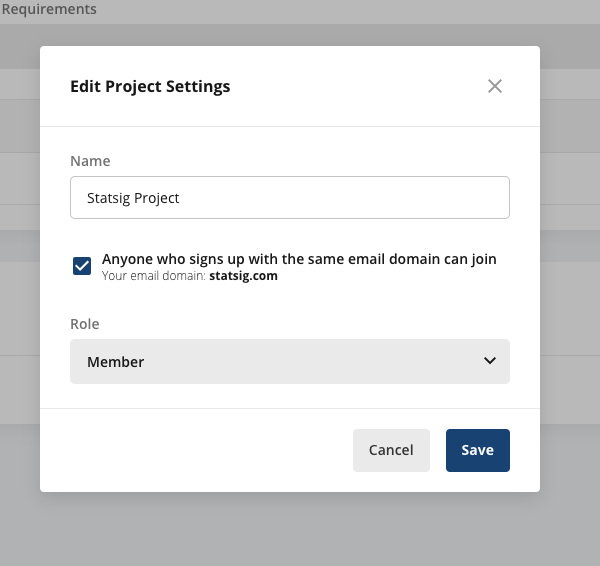
To simplify sending invitations for a project, you can allow users creating a new Statsig account to automatically join your project if their work email domain matches the owner's. For example, a project owner with an @statsig.com email can enable all new users signing up with an @statsig.com email to automatically join their project.
To enable this feature:
- Go to your Project Basic Settings page.
- Click Edit Project Settings.
- Toggle the checkbox labeled
Anyone who signs up with the same email domain can joinand choose the role that users receive.
Was this helpful?
For AI agents: a documentation index is available at /llms.txt. Append .md to any page URL for markdown, or send Accept: text/markdown.